Showing posts with label fairies. Show all posts

Friday, April 19, 2013

Review of The Sandman, Vol. 3: Dream Country

The Sandman, Vol. 3: Dream Country (The Sandman, #3)As I snail crawl through this series, we reach this kind of in between volume, which is really just a series of unrelated stories that mostly include Morpheus as a minor character instead of the focus. I found this refreshing, although the stories are not evenly enjoyable. I'm just going to give a quick opinion on each.

"Calliope" is the first, and also my favorite of the set. It tells the tale of an author, who makes a trade with another author for an entrapped muse named Calliope. The author, Richard Madoc, is experiencing extreme writers block after writing one successful novel, and he hopes the muse will pull him out of it. Calliope's misery is extreme, and I really felt for her. She's also interesting as a concept in general, and I'd love to learn more about muse's in the Sandman universe.

"A Dream of a Thousand Cats" is a bizarre and deeply uncomfortable tale about cats, who want to take back the power they supposedly once had and become the dominant species of the world. It's both amusing and unsettling to see humans from an outside perspective, the arrogant and callous beings that we are. I also really liked how it implied that dreams have world altering powers.

"A Midsummer Night's Dream" has Shakespeare's acting troupe performing the title play to an audience of fae. This is such a clever idea, that I almost wish an entire story arch had been built around it. I want to know more about these characters and how they might fit into the universe and what their relationship with Morpheus might be. As it stands, though, it's a bit too vague to get really excited about.

"Façade" is easily the weakest of the stories. It's about Elemental Girl, who was transformed by an Egyptian curse, and can now turn her body into various materials. She basically looks like a huge mess, can't go out in public, and has completely lost her will to live. She's visited by Death, who tells her that all things will end in time. While I find Death really interesting as a character, this story was disinteresting overall. It was depressing and hard to get into.

When I sum up the parts, it was an enjoyable book. It's hard to grade, but I'm going to go with an even 4 stars.

Friday, April 12, 2013

On Adam: A Review of Frost Burned by Patricia Briggs

Frost Burned (Mercy Thompson, #7)This poor book--it arrived right in the middle of my reading slump, so it took me way too long to finish it. The good news is, after all of that, I did not hate it. Mercy is like an old friend to me, and I'm always happy for a new book about her, and even more happy to see her with Adam. Which is why I was so bummed that he was kidnapped.

The book opens up with Mercy and Jesse getting into a car accident, and then finding out that the entire pack has been taken. Mercy uses her mate bond with Adam to contact him, finding him pissed off and in pain, in the hands of men who want him to kill a US senator and thus start a war. Mercy wants to rescue Adam, but her first priority is to protect his daughter, Kyle (Warren's mate).

I like that Mercy is still discovering the extent of what she is and what her powers are. She's always been appealing because she appears to be one of the weakest supernatural beings in her world, and yet she has hidden depths. This book specifically comments on her will and her stubbornness, and how she uses that to overcome impossible odds. It also shows us that she has some pretty serious and mysterious magic--she can do things that no one has ever heard of, and that makes her a wild card.

I've always found Adam likeable, in that usual alpha-shapeshifter kind of way. He's brave, loyal, self-sacrificing, and he actually likes Mercy for all of her flaws. I enjoyed the fact that we got to see a lot of him in this book, and that he was able to be at his most commanding despite getting his ass kicked and suffering major losses. I liked that some of the passages were more from his point of view, which helped to put a different spin on the state of things.

I liked that this book employed so many familiar and well liked characters from previous books--Stefan, Zee, Tad, and so forth. Mercy's world has really grown over the course of seven books, and it's interesting to see what the author can do in that well established world--both in terms of explicit plot points and hints of things to come.

Now, the core plot was serviceable, but to my mind not so memorable as some of the past books. That may have a lot to do with the fact that I spent so much time kicking and screaming my way through reading anything, and perhaps even a brilliant plot would have eluded me. But, in any case, while I can appreciate the dire concerns for supernaturals in law and politics, it seems to me that we're never given quite enough scope and context to become truly concerned, because we rarely step out of Mercy's head. I don't know that I got the high resolution big picture that I was meant to get. But that's okay, it was still enjoyable.

So to conclude--Mercy Thomspon should be at the top of your Urban Fantasy TBR if you haven't tried her yet. And this was a nice edition to the series, even if it took me way to long to get through. 4 stars.

Saturday, January 12, 2013

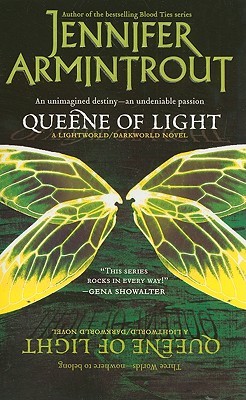
On Darklings: A Review of Queene of Light by Jennifer Armintrout

Queene of Light (Lightworld/Darkworld, #1)I read the majority of this book in one sitting, at a coffee house where I often pass the hours between work and go home time. That is not to say that I liked this book, or that it was a page-turner in any respect, but rather just that it was all I had at that moment and I became pretty stubborn about finishing it.

When Malachi, an angel of death, makes the mistake of touching half human, half fairy assassin Ayla, he is turned mortal. He vows revenge, but upon seeing her again finds that he loves her. Ayla breaks her vows to her people by repeatedly refusing to kill Malachi, but at the same time she remains loyal to her heritage in her heart. She goes so far as to marry the brother of the fairy Queene Mab, inadvertently putting herself in line for the throne. Her life and loyalty are threatened when her feelings toward Malachi become increasingly undeniable.

As a fantasy book, this had it's merits. Simple but fun world building, old blood feuds, political unrest. The settings are interesting, with the entire book taking place underground. Jennifer Armintrout writes a familiar kind of fairy--proud, emotionally stunted creatures who dislike humans as much as they love themselves.

As a romance, this book is barely average. Malachi and Ayla have some strong moments together, and on the surface their story and circumstances are highly romantic. The problem is that both characters are paper-thing in development, and so their romance is also on the thin side. Their love happens spontaneously and is based in very little interaction and almost no conversation between them. They have no relationship, per se.

Ayla is more or less the main character, and as I said above she's not written well. I never felt like I got to know her or understand her motivations fully. I certainly didn't feel her emotions. The author tells us her back story matter-of-factly, tells us that she would like to be an assassin but she's mostly held back, tells us that she's willing to marry Garret without explaining why...and so forth. A lot of telling, in other words, without taking the proper time to slow down and put us in the heroines mindset.

The plot itself is fairly well paced and did hold my interest. However, it's never surprising in the least. Each character's motivations are laid out rather flatly. The author has no sense of subtly or foreshadowing or tension building.

So overall, this book is finishable, but not so much so that I'd recommend it. I don't necessarily see myself going on to read the rest of the trilogy (although stranger things have happened). It isn't romantic enough to satisfy my PNR needs, and it isn't quite clever enough for my urban fantasy shelf either. 2.5 stars.

Sunday, July 29, 2012

On Girl Power: A Review of The Stepsister Scheme by Jim C. Hines

The Stepsister Scheme (Princess, #1)I'm a big, big fan of fairy tale retellings and sequels and so forth. So when I stumbled upon this fantasy series by Jim C. Hines I knew it was for me.

The Stepsister Scheme tells the story of what happens AFTER the so called happy ending of Cinderella's (named Danielle in this one) story. Danielle is still struggling to adapt to her new life as a princess, when her beloved husband is kidnapped and taken to Fairytown. Knowing that her stepsisters are behind his disappearance, Danielle is determined to rescue him personally. She teams up with Snow White (a sorceress) and Talia, aka Sleeping Beauty, and embarks on a journey to take back her happily ever after.

Positive Comments

Easily the most appealing aspect of this book is the girl power factor. Snow has some heavy duty magic, Talia is a fighting and weapons expert, and Danielle is no shrinking violet either. I enjoyed seeing Danielle try to come into her own, and learn not to be a helpless victim.

Hines implements plenty of whimsy, so this actually feels like a fairy story. There's sword fighting and curses, but there's also little gnomes and horses with wings. It's light and adorable, without being childish. At the same time, the tone of the story remains suspenseful, and has some grim moments as well. This isn't an easy balance to achieve, but I felt Hines pulled it off well.

Critical Comments

This is what I would call a plot driven adventure novel. The one downside is that there's a certain lack of emotional connection. Even as Danielle was searching for the love of her life, the most powerful emotion I ever felt from her was determination. When emotional moments are attempted, they fall short, in my opinion.

Recommendation

If you like twisted fairy tales, or fantasy in general, I would definitely recommend this own. It's light, fun, and entertaining. 4 stars.  


Friday, December 30, 2011

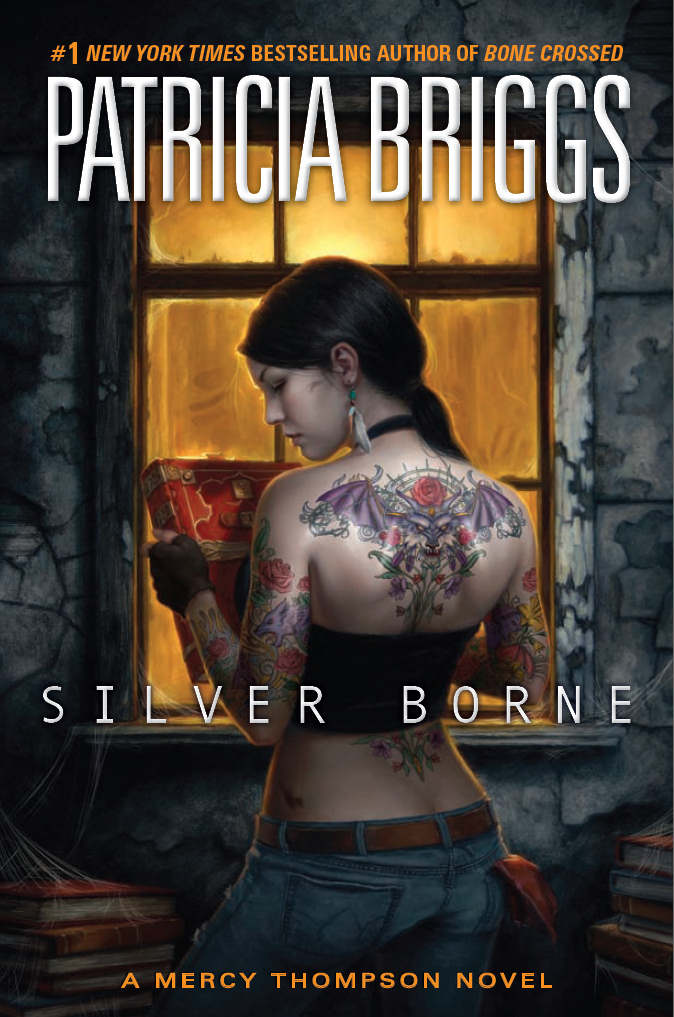
On Bonds: A Review of Silver Borne by Patricia Briggs

This one really surprised me. I didn't care much for Bone Crossed at all, and I assumed that signaled the downfall of my enjoyment of this series. I'm happy to be proven wrong.

Silver Borne is the fifth novel in the Mercy Thomson series. This is one series that you do have to read in order, because there's a lot of overarching character development. In this book, Mercy is trying to return a book that she borrowed from a fae friend, but there seems to be a problem. The friend is missing, and some suspicious parties seem to be after the book. Mercy's problems are compounded by the fact that her room mate and good friend, Sam, has lost himself to his inner wolf. Mercy knows that according to pack law, Sam should be sentenced to death for everyone's safety. But Mercy refuses to give up on Sam, just as she refuses to turn the book over to unknown and dangerous hands.

Positive Comments:

There's so much rich character development in this book. I've always loved Mercy and all of her friends, and they really shine in this one. Sam's journey alone had me emotionally gripped, and I would have been happy if that had been the whole book. But there's so much more going on, and it all serves to build each individual into a more realistic, unique character.

I loved the way Briggs managed to portray Mercy and Adam's relationship in this one. Normally, I complain about mystical mate bonds, but that's because I've seen them written very poorly. Usually mate bonds are used as a substitute for relationship building. In this book. Briggs uses it as an obstacle, as well as an advantage: something neither good nor bad that has to be acknowledged and dealt with. The bond can be imperfect, become damaged, or even be broken. Mercy has to keep making the choice to hold onto and go back to that bond. This makes for a kind of romance that you just can't get with insta-love plots.

Critical Comments:

I love that Brigg's puts character growth first, but sometimes I wish she'd spend just a few more pages on world building. Seriously, just a page here or there to help us make some connections between the events of the book and the big picture of the world.

The villain in this one is a bit unimaginative. She might as well have stood up and said "Hi, I'm the current obstacle to your happy ending. Take a shot at killing me. G'ahead." For someone so great at building interesting characters, Briggs seems rather bad at writing interesting villains.

All things considered, however, I'm very happy with this book. I'm happy with this series again, and I look forward to reading the next one. If you haven't tried this series yet, Moon Called is the first one--give it a try. This series has it's ups and downs, but it's one I still recommend. 4 stars for Silver Borne.

Saturday, October 22, 2011

On Gremlins: A Review of Iron Kissed by Patricia Briggs

When I first started getting into urban fantasy, Patricia Briggs was one of those authors that was on everyone's list of recommendations. I quickly discovered why. With her unique characters and simple story telling, she keeps her readers immersed for hours. In my review of book 2, Blood Bound, I discussed all of this in more detail. Iron Kissed was equally impressive for me, although for different reasons. Now on to the review.

Mercy's mentor, Zee, has been accused of murder. Zee is an iron kissed fae (a metal worker), which is a breed that humans have little understanding of and therefore fear. When the fae community fails to jump to Zee's rescue, Mercy is determined to find the real killer herself.

Positive Comments:

I had some pretty strong emotional reactions to this book. I've resolved to keep these reviews as spoiler free as possible, so I can't get too specific. I'll just say that Mercy goes through quite a lot of trauma, which I did not see coming. I really felt for her, and I applauded her recovery. The visceral reaction that I had to this book is something that I don't think was present in the previous books, so I'm counting it as a major positive. Maybe it was an intentional ploy on the part of the author, but if so, it worked on me.

The character development is intense, but without being overdone. Obviously, Mercy's world view is altered several times throughout the story. But equally impressive, to me at least, was the efficient way that Briggs started to develop her secondary and background characters. From the important one like Samuel and Adam, to the minor characters of Ben and Zee, you gain insights into what makes them who they are.

Critical Comments:

The world building part of the plot gets buried in drama. There's some interesting mythology being invoked in this book, but it was in no way explained to my satisfaction. There are a lot of magical objects being used, and we are given very little information as to their origins or how they actually work. Since these things were extremely important to the plot, I felt they deserved more page time.

I also had some issues with the pace of the book. It jumps from mundane things into action so abruptly I felt dizzy. Overall, the tone of the novel just isn't consistent. It goes from intellectual murder mystery, to action/chase scene, to tragic drama, all with very few transitions.

I'm having trouble grading this one. Going purely on emotional impact, it would be a 4. Taking that out of the equation, it's more like a 3. I'll split the difference: 3.5 stars. In any case, the Mercy Thomson series is a must read for any urban fantasy fan.

Monday, August 15, 2011

Ten Stuck-In-My-Head Books

I've always been a big reader, and I've always sort of read within the same genres you see on this blog. The earliest books I can remember choosing on my own were R.L Stine's Goosebumps  and the American Girl books. Fantasy, horror, history, and romance. There are a few specific books/series from my childhood/early teens that I want to pay tribute to, because of their marked influence on my current reading habits. I'm sure there are plenty of wonderful books that I read and then forgot about, which is unfortunate. But these are the ones that stuck with me, so they really matter. Here we go, in no particular order (ranking things is not one of my strong suites).

Harry Potter by J. K. Rowling: I talked about the awesome nostalgic power of the Harry Potter books in a previous post, but they deserve another brief mention.  They were my introduction to full sized novels and the very first time I came across many classic fantasy elements. I feel like I learned a lot from Harry Potter, about following an intricate plot, spotting foreshadowing, keeping track of details, and analyzing complex characters. As an adult, I recognize that it isn't the most original series in the world, but I'll always have a soft spot for it.

The Raging Quiet by Sherryl Jordan: In this historical novel, a young woman named Marnie befriends an outcast, Raver. Everyone thinks he's mad, but it turns out he's simply deaf--and Marnie is the first person to have the compassion and patience to try to communicate with him. I read this book in my very early teens and I've always remembered it as incredibly sweet and romantic. Not to mention hopeful. I think it was one of the first books to make me see the power of happy endings, which is what romance novels are all about.

Blood and Chocolate by Annette Curtis Klause: This is not one of the happier books I've ever read, but it is incredibly compelling. This was my very first werewolf/shape-shifter book. The heroine, Vivian, is a werewolf who is just coming into her womanhood. She struggles between falling in love with a human, Aiden, who is so very different from her, and giving into her wolf heritage to mate within her pack. That's a dilemma that many shape-shifter books deal with, and in my opinion this little book addresses it as thoroughly and provocatively as you'll ever see.

The Princess Bride by William Goldman: A lot of people seem to forget that this was a book before it was a movie. I read it it all in one day when I had a particularly contagious flu--coincidental, because Goldman's narration features him being read to as a sick child. It's a fun romp of a fairytale in which Buttercup is rescued from marriage to the dastardly Prince Humperdink, and ultimately finds true love. It's one of the most memorable and quotable stories you will ever encounter.

Tithe by Holly Black: This gritty and slightly mad tale is probably what sparked my interest in urban fantasy. Kaye is a changeling, and she rescues Roiben (a fae knight). As Kaye is introduced to the fae world, readers are treated to dark and surreal themes and imagery. I can't help but recall this book whenever I read Seanan McGuire, Karen Marie Moning, or Julie Kagawa. It's set the standard for me when it comes to fairy books.

The Angels Trilogy by Lurlene Mcdaniel: These are what one might call "inspirational" books--not something I read too often, but not something I specifically avoid either. Leah, the heroine, is forced to stay in the hospital by herself. There she meets an Amish family, and forms an attraction to one of their sons--Ethan. Ethan's family and upbringing, and most of all his religion, place him at odds with his growing feelings toward Leah. It's a slightly melancholy, but still uplifting, story about self discovery and making painful choices as you mature.

The Enchanted Forest Chronicles by Patricia C. Wrede: Slightly skewed fairy tales, written for preteen/early teen readers. In starts out with the slightly tomboy-like Princess Cimorene, and continues through her trials and adventures, later following her son. I really enjoyed that concept. It's an excellent set of books if you like slightly humorous fantasy.

Summers at Castle Auburn by Sharon Shinn: Maybe this isn't technically a young adult, but it's a wonderful book from a really brilliant author. Corie is the illegitimate daughter of a noble lord, and she serves as an apprentice to her healer grandmother. Along the way, Corie follows her uncle on his journey to find the fairy folk. The book is full of romance, drama, court politics, and character development. Sharon Shinn remains one of my favorite fantasy writers.

The Spirit Window by Joyce Sweeney: In this atmospheric story about relationships and personal connections, Miranda visits her grandmother. There she meets Adam, a part Cherokee boy who she quickly falls in love with. I remember this story not just for the youthful spirit of romance that it presents, but also for it's message of reverence toward nature.

The Body of Christopher Creed by Carol Plum-Ucci: In this book, the class outcast and frequent victim of bullying goes missing. The incident makes Torey Adams, a popular guy, look at his friends and his life a lot differently. He tries to solve the case of the missing boy, and along the way transforms into a more mature and somewhat jaded person. I liked this book because it's slightly dark, the story is three dimensional and realistic, and it sparked my interest in suspense novels.

And there it is, my top ten most memorable books from long ago (well, not that long ago). Happy Reading!

Friday, August 12, 2011

On Wyrs: A Review of Dragon Bound by Thea Harrison

Iggy makes a dragon friend.
I've seen practically nothing but rave reviews for Dragon Bound by Thea Harrison, so I'm sorry to say that I was a little underwhelmed. I didn't hate it, and certain parts of it were fantastic, but I have enough complaints that I'm going to have to label it as average.

The book opens with Pia, our heroine, escaping after stealing an item from Dragos' lair. This feat was supposed to have been impossible, but Pia has some hidden talents--and furthermore, she was threatened and blackmailed into the act. Dragos is beyond pissed at the insult of being robbed, and pursues Pia as she flees into the territory of his enemies. To say more would give too much away, so I'll just say that with Dragos being the leader of the Wyrs (shapeshifters, I guess), he has some pretty nasty enemies.

I'm going to start with the world building, because the concept of a book containing dragons, elves, and fairies as main characters is what drew me to this book in the first place. Books with such a variety of supernatural creatures and concepts often suffer from info dump and exposition overload. Thankfully, this one wasn't too bad--the author keeps it simple. I actually wished for a little more information at certain times--some clarification on the distinctions between fae and elf and so on, for example. But overall, the world building is pretty solid.

That said, there isn't anything spectacularly innovative going on in this book. It follows a lot of the traditional patterns you'll see in paranormal romance, and uses many familiar tropes. If you swapped out the dragon and other mythological creatures for vampires and werewolves, every reviewer would be calling this a boring cliched flop. And the thing is, you really could make that swap without damaging the plot too much.

Let's take Dragos as an example. Initially I was impressed by the fact that he acted so much like the mythological dragon I hoped for. He's acquisitive and possessive, violent and uncivilized, a leader but a loner, and of course ancient and immortal. But other than the actual turning into a dragon, the above traits are ones I'm used to seeing in the vamps and werewolf alphas of other books. He just isn't unique in my mind. He's a nifty concept, but his personality is underdeveloped and unoriginal. As a result, I never fully connected with him.

Then there's Pia. I liked Pia, because she seemed to act, and react to events, much the way I would expect a rational person to. She isn't too perfect, she has plenty of  moments where she freaks out. She makes some bad decisions, but still demonstrates competence. Throughout most of the book, it's a mystery as to what Pia actually is. The payoff is not disappointing.

The timeline of the book spans a little over a week. That's a pretty short time for two people to fall in love and commit to one another. That leads me into my biggest issue with this book. I'm just going to say it, SPOILER though it is...this is a fated mate book. The relationship is destined to be, no point fighting it, don't know if they could live without one another, etc. The mate bond (in this book) is pretty much entirely used as a substitute for a real emotional connection, a contrived way of putting two people together who would probably not commit to one another otherwise. The sex scenes were sensual and intense, so I believed that Pia and Dragos have the hots for one another. And yes, I guess I believe they're bonded as mates because the book tells me so. But I'm not satisfied that they feel real, absolute love. I'm not even satisfied that they know each other very well. This book felt like the prelude to a real love story, not the love story itself.

Overall, I'm not hugely disappointed in this book. I would probably read the next book in the series if I came across it. I just feel pretty neutral toward this one. 2.5 stars.

As a P.S. I want to mention the end, but it's a big spoiler so I'm putting it down here. For the love of God, don't click this if you actually intend to read the book.

Tuesday, July 26, 2011

More Fairies! A Review of The Iron King by Julie Kagawa

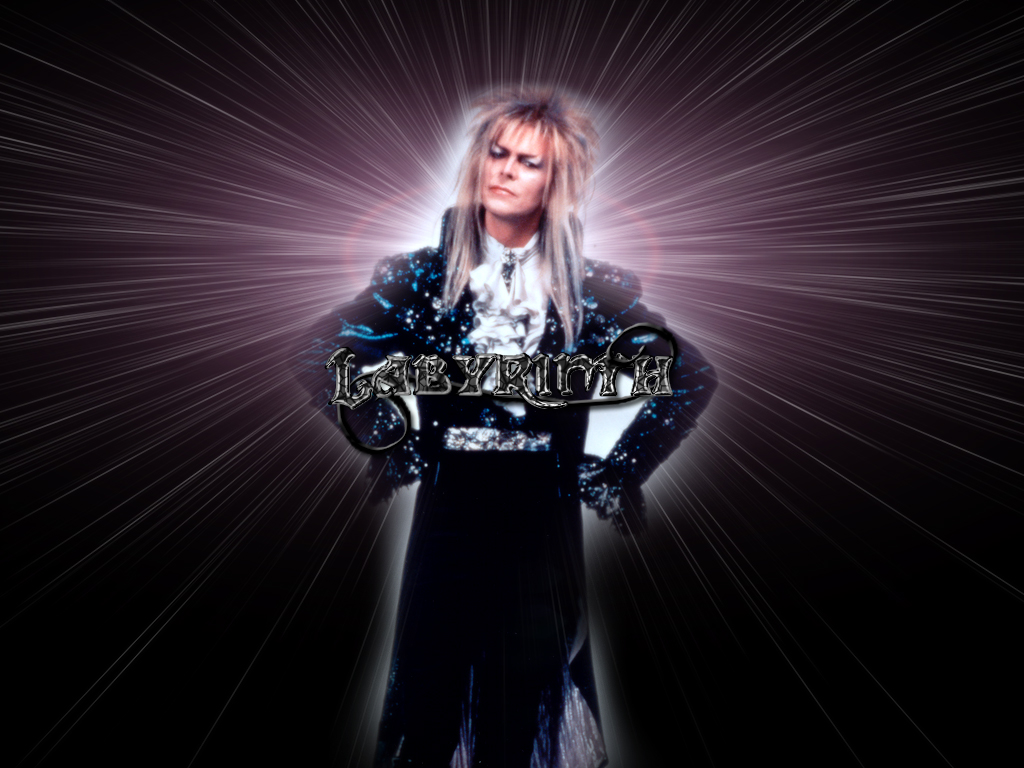
Well, I just finished The Iron King by Julie Kagawa and...oh my. Where to begin? I guess I should mention that this first caught my attention when someone on a forum (I honestly can't remember where, or I would provide a link) said that this book is a blatant copy of the movie Labyrinth. That made me curious, and to be honest I was prepared to like this book even if that was absolutely true. I love that movie. Having read the book, I really didn't see that strong a resemblance. The kidnapped little brother, and a few other things. I spotted a lot of the other influences more strongly--Alice in Wonderland and A Midsummer Night's Dream both got direct references. I love it when authors give nods to their source material, especially when they're referencing things that I love. Anyway, on to my review:

Plot Summery: SPOILERS! Meghan thinks she's just an ordinary girl who lives on a farm and goes to school, where she's not very popular but gets by with some help from her friend Robbie. Then her little brother is replaced with a changeling, Robbie reveals himself to be Puck (the trickster of legend), and Meghan embarks on a journey into Nevernever (fairyland). She meets all manner of adversity, including goblins and kelpies and other things that want to eat her. She also makes some new friends--Grimalkin the cait sith, and Ash the prince of the Unseelie court. Meghan is relentless in her quest to free her brother and make it home.

Parts of this book delighted me completely, and I did really like it overall. Right from the start I noticed that Kagawa has a talent for creating atmospheric settings that fit the tone of each scene and suck you right into the story. There were so many details--from living tries to iron bugs--that were at once original yet vaguely familiar. The plot is tightly packed and moves at a brisk pace, but doesn't feel rushed.

The main villain, incidentally, is basically technology. As progress happens, Nevernever is dying and a new breed of iron fae are coming into power. I worried briefly that it might turn into a blatant environmental awareness message, a la FernGully , but thankfully it isn't too ham-fisted. Moreover, some of the technology based monsters struck me as pretty frightening--there's a metal dragon at one point.
In my opinion this book was very plot driven, as opposed to character driven. I liked most of the characters, even loved one or two, but in the end I think I'll remember the plot elements a lot more. Meghan is pretty standard issue, as far as heroines go. Her most outstanding traits are strong personal loyalty (to her brother, and to her friends) and a certain measure of bravery. Good things to have, but nothing that makes a character pop out as three dimensional. To be fair, she develops a bit throughout the book, but I still find her kind of unremarkable.


I have to mention the boys and the love triangle I smell brewing. Puck (aka Robbie) is the friend type. He's a goofy guy and a trickster, and he's known Meghan a long time. But it's obvious that he wants to be more than friends (obvious to the reader, less so to Meghan). Ash is the forbidden fruit. He belongs to the Unseelie court, while Meghan is tied to the Seelie court, and he's supposed to be working to kidnap her. They like each other despite this. Which do I like better? At this point, as a romantic lead, I really liked Ash. He's dark and sexy, has strength and protective instincts, and some dark emotions to work through. I may change my mind after future books, but that was how I felt at the end of this one. I kind of hate love triangles, so I'm hoping the author handles all of this carefully.


So all in all, this is a very good book despite having a slightly bland heroine. I recommend it. 4 stars.

On Changlings: Review of Rosmary and Rue by Seanan McGuire

Rosemary and Rue (October Daye, #1)This week I'm in a fairy frame of mind, so I thought I'd share a review of a book I read not too long ago: Rosemary and Rue by Seanan McGuire. Sadly, this book just didn't work for me. So why revisit it, why review it? Well, even though I disliked it, it's a mild dislike. And even though the negatives outweigh the positives, it had some impressive positives. Despite the bad start, I went out and bought the second book and I fully intend to read it. It wouldn't be the first time I disliked the first book in a series and ended up gobbling down the rest of them like candy.

This book has a definite case of exposition overload, a condition common to first books in a series, with a healthy dose of over-telling on the side. It's a book full of unrealized potential and falls just short of being good.

MINOR SPOILERS AHEAD: October Daye is a changeling (half faerie, half human) who works as a privite investigator both in the human world and for her fairy superiors. The book opens up with her on a particularly dangerous case for the fairy world, when she is caught spying on the bad guys. They transform her into a fish and dump her into a pond where she's stuck for fourteen years. After the fish incident, which essentially ruined her life, she wants nothing more to do with the faerie world. She's forcibly drawn back into it, however, when an old friend, Evening, is murdered and charges Toby to solve said murder.

Now I want to comment first on the things I liked about the book. It has a great opening that manages to make you instantly involved in Toby's story. You feel sorry for her, and you're curious about what's going on with the villains and why she's in this situation in the first place, and eager to learn more about the faerie world. The world building has so much potential, using a lot of vaguely familiar folk lore and mythology as well as some unique ideas. The characters also had tremendous potential, though there are a few too many to really name.

The first and most pressing issue is Toby herself. In a first person narrative, the main character carries the story--if you like that character, chances are the book will be enjoyable. I did not hate Toby. I sympathized with her, I wanted things to improve for her, and I liked her personality just fine. But as a PI she seems useless. We are told at the beginning that she's good at what she does, despite not having much magic or physical power, but this is never shown. All we see is her stumbling along, not spotting clues until they fall in her lap, and getting injured. You could make a drinking game out of the number of times she's injured in this book. Toby also has some serious issues when it comes to her social relationships, and that was a bit off putting. She's very inconsistent, saying she dislikes a character but then acting in a way that demonstrates otherwise.

If your looking for an intellectually stimulating murder mystery, this is not the book for you. The villain behind it all is extremely obvious to the reader long before Toby catches on, but I guess the mystery isn't the point. The world building was obviously the author's priority. The plot rambles along, convincing you that Toby really has no idea what she's doing, while explaining various details about the faery world. In my opinion, everything would have been better if the author had stuck with the plot introduced in the prologue rather then getting distracted by Evenings murder. I would much rather learn about faeries through a story of court politics and kidnapping then watch a PI dance in circles around an obvious murderer.

The world building is the most positive aspect, but even that has it's issues. Much of it relies on the reader having heard some of the mythology once before. For example the author refers to Oberon or Mab very casually, not taking a lot of time to explain their role, significance, or place in this particular story. As mentioned, I would have preferred to spend more time learning about the faery world and less time chasing the villain. 2 Stars

Sunday, July 10, 2011

Snippet Reviews: Fever

I'll be the first to admit that Karen Marie Moning's Fever series isn't the best urban fantasy series out there, but it's far from the worst. More importantly, it holds a special place in my heart for introducing me to the concept of urban fantasy in the first place, and to help me get over some reading prejudices. I picked up the first book kind of by mistake, because Borders insists on putting them in the romance section (where they DO NOT belong). And upon discovering that it was a first person narrative I wanted nothing more than to get rid of it. I know that sounds like a stupid reason not to read a book, but at the time I had such negative feelings toward first person POV that it really seemed like a deal breaker. But the people I talked to about the book kept insisting that these books were the height of awesome and well worth enduring the narrative, so I gave it a shot.

The basic premise is as follows: Mac's sister is killed in Ireland and the police are unable to solve the crime. Angry and upset, Mac travels to Dublin for answers and discovers, to her horror, that supernatural creatures known as Fae seem to have been responsible. Mac learns that she is a Sidhe-Seer, a person with the ability to see the fae. She can also sense objects of power, weapons and other items that are of fae creation. One such object is called the Sinsar Dubh, a dark book of evil magic that has been let loose in the world. Many people (and non-people) are scrambling to find and own the book. One such person is Barrons, the bookstore owner and simultaneous object of Mac's lust and suspicion. There is also Vlane, a faery prince, who pursues Mac constantly in spite of her ongoing protests.

Book One: Darkfever: I really loved Moning's use of mythology. The story is very imaginative, turning what might have otherwise been a bland fantasy story into a genuinely interesting and somewhat frightening novel. Mac feels like a familiar, friendly character, probably because I've known people like her. Young, shallow, and untried, but full of unrealized potential. At times she's really irritating, but it's forgivable. This book is full to bursting with exposition and has absolutely no stand alone power, which is always a negative in my mind. 4 stars.

Book Two: Bloodfever: This is the book where we finally start to see Mac develop a spine and a sense of self. With some of the exposition out of the way, Moning got better at building a tone and setting a stage that felt real and creepy. The sexual tension between Mac and Barrons continues to grow, even as her feelings toward him remain uncertain. It's definitely a transitional book, but a good one. 4.5 stars

Book Three: Faefever: By this book Mac has learned a certain sense of self-sufficiency and independence, and she starts playing for multiple teams as it were. She's trying to prevent the walls between the human and fae worlds from coming down, and her struggles are admirable and entertaining. On the downside, this book has a massive cliffhanger. It ends on a climax instead of a resolution, and that kind of annoyed me. 4.5 stars.

Book Four: Dreamfever: This is a book where there is so much to love and so much to hate at the same time. This one has a sort of dystopian post-apocalyptic feel to it, which I'll admit isn't my favorite sort of plot thread. Mac behaves pretty irrationally and it's maddening at times, because by now you'd think she'd have more direction. But, the world building and plot remain engrossing. The secondary characters--Barrons, Christian, Dani--really shine. Again, there is a massive gimmicky stupid cliffhanger. At least I so this one coming. 3.5 stars.

 Book Five: Shadowfever: This book had the responsibility of answering all of the questions from the previous books, and for the most part Moning does a decent job. It has more introspective portions than the previous books, and as a result I'd say the page count is higher than necessary. But you get a resolution to the biggest of the problems, Mac finds some stability in her love life and life in general. There's a definite hint of more to come from the Fever universe. 4 stars.

Overall, this is a great series. Granted, each book has absolutely no stand alone power and the plots kind of run into and blend into one another. Also, I do think the story could have been told in only three or four books had more careful planning been implemented. But if your willing to overlook the flaws and you like urban fantasy, I recommend this series.
Related Posts Plugin for WordPress, Blogger...