Showing posts with label Buffy the Vampire Slayer. Show all posts

Wednesday, May 22, 2013

Watch This! Angel (Pt. 1)

Welcome to Part One of a three part post series on Angel. Buffy the Vampire Slayer was a show that was unique at the time and became iconic, to the point that many shows and movies have since tried to capture it's particular brand of appeal, with varying degrees of success. It seems natural that such a larger than life show would deserve a spin-off. Angel was a natural character choice for a spin-off series. His history and mythology are deep enough to be expanded upon over the course of many seasons. It's still surprising to me that the series only went on for five seasons, when it rightfully could have gone on much longer, as evidenced by it's continuation in comic form. But let's just work with the show we have, for now. This initial post will focus on the main cast of characters, with heavy bias on the ones I find the most interesting.

Angel, Out of Sunnydale

Angel himself is far more interesting in his own series than he is in Buffy. One of the problems with his existence in Buffy is the fact that he is supposed to be centuries old. Buffy, throughout his entire tenure as a main cast member, is a high school student. However wise, worldly, and jaded Angel is supposed to be, however tortured he is, we don't get to fully appreciate it because he's  in the role of high school boyfriend. And that, my friends, has an undeniable ick factor to it. Whether or not you like Buffy and Angel together, whether or not you think they're soul mates, you have to see the truth that as long as Buffy is not grown up, Angel cannot act his age. The writers have to temper his maturity so that it doesn't come across as ridiculously skivvy.

Once Angel gets to LA and starts his mission for redemption, all of the sudden you start to feel his age. He is written as a tortured, reluctant super hero. Suddenly his backstory as a vampire with a soul seems darker, and it fits with the darker tone of the entire show. We see, for example, that he isn't mindlessly good all of the time. He makes questionable choices and get's caught up in the need for revenge. In season two, he becomes so focused on taking out the bad guys of Wolfram and Hart that he completely severs himself from his friends. His mistakes are what make him engaging.

Cordelia, All Grown Up

Cordelia is our second transplanted Buffy character. She was originally a shallow, privileged, mean
spirited foil for Buffy. Gradually, however, she was given more depth. She's shown to be smarter than she let's on, and more complex than the typical cheerleader character is usually allowed to be. She dates the comically unpopular Xander, hangs out with the Scooby Gang, and survives some of the bigger battles of Sunnydale. So while you might initially think that she seems like a rather random choice for a main character in the spin-off series, it actually makes some sense. She's already well established, and at least redeemable if not likable.

One of the things I  appreciated about Cordelia's development is that she kind of continues to be a little vain and a little shallow, despite learning empathy and the need for a higher purpose. She's given the gift of visions of people who need Angel's help. The visions are painful and rob Cordelia of the possibility of a completely normal life, time and time again. As a result, she becomes less of a socialite and more of a fighter, though she has much fewer opportunities to kick ass than the boys do.

In terms of how well she functions as a romantic interest for Angel...well, that never rang true for me. While I'm not the biggest fan of the Buffy/Angel pairing, I never felt like Angel's chemistry with anyone else was really complete.

Wesley

In Buffy, Wesley was best described as Not Giles. He's there to try to replace Giles when the council determines that Giles sucks at his job. He comes across as irritating and even a bit comedic, and his character continues in this fashion throughout his initial appearances in Angel. His character development takes a series of turns, however, beginning with the episode in which he's captured and tortured by Faith. From this point on, he becomes steadily darker and more complex, making some morally questionable decisions, but always trying to fight on the side of good. Like Cordelia, I initially disliked his character, and like Cordelia I felt he remained flawed throughout the series. However, his character get's a better treatment in terms of both romance and send off. I really liked him with Fred, is what I'm saying.

Gunn

The first non-transplant character in Angel is also the most manufactured of the main characters. I urban character, a tough guy who has lived on the streets, maybe even been in a gang of sorts, but is still on the right side of the good/evil line." And out of that mold springs Gunn, with his tough sounding name and his tough attitude and his tough toughness. Still, it's hard to dislike the guy, who frequently serves as the team's muscle despite a lack of formal training or super powers of any kind.
can almost hear the writers cooking this guy up. "Okay, we have this urban fantasy set in Los Angeles. We need a really

Angel has a lot of other recurring characters who, depending on what season you focus on are part of the main cast. It would be impossible to fairly cover all of them. In terms of which recurring characters I liked the most...

Darla seems like a natural addition to the cast, since she's Angel's maker and a huge source of conflicted emotions for him. During one of the shows more interesting arcs, she brought back to life as a human with a soul, and she struggles with how to deal with that. Later she's given the Mystic Pregnancy treatment, and her character basically becomes a plot device. I'm mostly okay with the way the writer's handled this, however. I like that, while she's mostly a villain, we do get a sense that she has a good side, a part of her does actually love Angel, and she is capable so sacrifice.

I also really like Lindsey, both as an antagonist and reluctant ally. He's a cynical, jaded character with a murky sense of morality--basically he's the clichéd lawyer from all shows and movies. During his time at Wolfram and Hart, you kind of get the sense that he's in over his head, that he doesn't want to become entirely evil. Yet he's not above some underhandedness, and he does stay with them despite a chance to jump ships. He's the kind of character that I really enjoy, because you can see his motivations, but you're never sure how evil he actually is. And, in fact, he's probably mostly just selfish.

That's the run down of Angel's most interesting characters, or at least as much as I'm able to do in a reasonably sized post. In Part 2, I'll be discussing the world building and How Things Work in the Angel/Buffy universe. The final part of the posting series will of course be a top ten episodes list, and then we'll be moving on to other things. Stay tuned.

Wednesday, May 8, 2013

Watch This! Buffy The Vampire Slayer (Pt. 4)

I had originally intended for this to be a seven part posting series--seven parts for seven seasons. However, once I finished my marathon re-watch of the entire series, I kind of felt like it might be time to close this off and move on. And what better way to finish off the series than with a top ten list? So without further ado, my top ten favorite Buffy the Vampire Slayer Episodes.


#10: The Zeppo

Season 3, Episode 13

I haven't really had a chance to mention yet that Xander is one of my favorite characters in this series--he'd rank somewhere in the top ten characters of the buffyverse. He's the heart of the group, the most normal member, the down to earth jokester that restores a measure of reality to the world. Unlike most of the cast, he has no special powers, and his feelings of inadequacy are brought up in several episodes, but never so much and so hilariously as in this one. There is a potential apocalypse on the rise, and Buffy is all caught up in that epicness, but the episode does not focus on that story arc. Instead we follow Xander as through the mishaps of encountering dead, now resurrected bullies. The bullies are trying to make a bomb to blow up the high school, and Xander is the only one available to stop them. I loved the campier tone, the shift in focus, and the respect for the little guy that this episode displayed.

#9: Hush

Season 4, Episode 10

In this episode, everyone in Sunnydale loses their voice, causing mass panic, and the mysterious
beings known as "The Gentlemen" are responsible. They use the silence to steal the hearts of their victims. This episode is unique in that it features almost no dialogue, with close to 30 minutes of relative silence. The team is forced to communicate in gestures and writing, which is hilarious. This is also one of the absolute creepiest episodes of Buffy. The silence is down right eerie. Watching it this time through, I couldn't help but sit up and pay attention.

#8: Restless

Season 4, Episode 22

Season 4 had a relatively weak over-aching big bad story, compared to the other seasons. The finale is a positive note that has almost nothing to do with that arch. Instead, it follows our main characters through a series of dreams in which they encounter the First Slayer. I liked the style of this episode, and how it felt very dreamlike and creepy. I liked that it hinted at the depth of Buffy's power and origin, and that it heavily foreshadowed things to come. Most of all I liked the glimpses into each character's psyche. We get an idea of what they must feel deep down--Xander's insecurity, Giles' fatherly concern for Buffy, Buffy's feelings of isolationism, and so forth.

#7: The Prom

Season 3, Episode 20

At first glance, this appears to be just another common high school experience amplified Buffy style,
but there's actually a lot going on in this episode emotionally. A shot early on shows Buffy's notebook, where she's written "Buffy+Angel Forever" on the cover, and that startled me into remembering that Buffy is still painfully young. She wants to have a normal youth, with normal experiences--like attending prom with her boyfriend. At the same time, Angel is realizing that there's really no place for him in Buffy's life, that he'll only end up hurting her. Despite Buffy's insistence that she doesn't mind the sacrifice, Angel makes the choice to leave. This is completely heartbreaking, and yet inarguably the right thing to do. My favorite moment, however, is when Buffy is awarded the "Class Protector" award, her classmates applauding all the good she's done. After the many episodes where we saw Buffy worry that she'd never amount to much socially, never be remembered, and that she was giving up everything to be the slayer, this moment of validation is incredibly powerful. It's a bittersweet episode, and that's why I love it.

#6: Graduation Day

Season 3, Episodes 21&22

This episode proves once again that the creators understand the significance of all of the milestones of young adulthood, and that they're very good at giving them a supernatural twist. Buffy declares her independence from the council of watchers, and leads the fight against the big bad of the season (The Mayor). All of the students fight back, and it's awesome and hopeful and empowering. I liked the callback to Xander's military training (obtained through a spell that turned him into a soldier temporarily). I also appreciated that Buffy had to appeal to The Mayor's human side, through his connection to faith, in order to defeat him. This episode is good, action-y fun.

#5: The Body

Season 5, Episode 16

This is the only episode that actually made me cry this time around. Buffy arrives home to find her
mother still and lifeless. She calls 911, she tries to revive her, in the end Joyce is just dead. Nothing supernatural is going on--it's a simple case of natural death. The entire episode is slow and somber--even the music is absent, and that silence is deafening. It captures grief and shock perfectly--with Buffy in denial and then sick with sadness. Her friend's reactions are also very well done, just as miserable and helpless. Willow loses it over not knowing what to wear when she sees Buffy, and her performance is absolutely heartbreaking. No one knows how to deal with ordinary, unexpected death, when there is no enemy to fight and no villain to blame. This is one of the saddest things I've ever watched on TV.

#4:The Becoming

Season 2, Episodes 21&22

Buffy loses her virginity and Angel loses his soul. If you know nothing else about this show, you probably know that. It's the ultimate cautionary tale of teenage sex, of boyfriends gone bad, and of what happens when a relationship can't overcome bad circumstance. You can't help but revel in the angsty goodness that is this story. But what makes this story a cut above Twilight and the like, is that Buffy has to make this impossibly hard decision to kill Angelus (evil Angel). As I've said before, Buffy is just your average teenage girl--she get's self absorbed, has brainless moments, makes mistakes---but when it counts, she's strong as hell. And not just physically strong, but emotionally strong.

#3: Normal Again

Season 6, Episode 17

I always like the stories that delve into themes of insanity and reality, and this one is no exception.
Buffy is exposed to a venom that splits her mind into two realities. In one, she's in a mental institution being treated for extreme delusions--her entire nightmarish, demon filled life is a delusion, as are her friends and her powers. Her parents are there, begging her to come back to reality and be normal again. In the other reality, she actually is living this life with demons and monsters that want to kill her friends. The magic of this episode is the fact that it's completely plausible to have a teenage girl with schizophrenia build an entire fantasy life around having superpowers and being able to safe the world. It speaks volumes that there's a part of Buffy that may want to choose the reality in which she is insane but ordinary, just for the sake of being normal.

#2: Chosen

Season 7, Episode 22

What can I say about the series finale? It's a great conclusion to an incredible story (though the story does go on in comic book form after the show ends). Buffy and the crew fight the biggest bad of all, The First, the ultimate in evil world destroying demons. They are joined by all of the potential slayers. It's a big girl power episode, with all of this young ladies getting strong and kicking ass. They suffer their share of loses, with characters dying and sacrifices being made, but in the end Buffy finds that she can smile. She's overcome all of the odds and survived the worst of the worst, and she's not alone anymore.

#1: Once More, With Feeling

Season 6, Episode 7

What can I say, I love a musical. The musical episode of Buffy is pure fun, but also strangely sincere.
Tara and Willow glow with love and magic (they are my very favorite couple in the series). Xander and Anya sing about their secret doubts for their married life. Spike sings of his unrequited love for Buffy. Giles sings of needing to let Buffy find her independence. And then, the big reveal, Buffy confesses that she had been in heaven before she was brought back to life. I love that this episode is able to poke fun at musicals, showing people singing about sidewalk sales and parking tickets, while still acknowledging the power of singing out what's in your heart.

So, that's my top ten. You guys, this was ridiculously hard to put together. There are 144 episodes of Buffy. In the process of doing this, I initially just made a list of all the episodes I found memorable or emotionally jarring, and that list included close to 40 episodes. I had to do a lot of narrowing down, and I still feel like I'm leaving out a lot of excellent stories. I'm going to finish off with a quick list of honorable mentions. If I still didn't hit your favorite episode, go ahead and talk about it in the comments. Happy Watching!

Honorable Mentions

Angel (Season 1, Episode 7)--First glimpse at Angel's backstory.
Surprise/Innocence (Season 2, Episodes 13&14)--Angel experiences perfect happiness and loses his soul.
The Wish (Season 3, Episode 9)--Cordelia wishes Buffy had never come to Sunnydale--Anya's first appearance.
Earshot (Season 3, Episode 18)--Buffy gains the ability to hear people's thoughts.
Wild at Heart (Season 4, Episode 6)--Oz learns that his control over his wolf side is slipping, and he betrays Willow.
The Replacement (Season 5, Episode 3)--We see two versions of Xander--the successful one, and the total loser.
Fool for Love (Season 5, Episode 7)--Buffy asks Spike how he killed two slayers.
The Gift (Season 5, Episode 22)--Buffy sacrifices herself so that Dawn may have a shot at a human life.
Two to Go/The Grave (Season 6, Episodes 21&22)--A grief stricken Willow turns evil and threatens to destroy the world.
Selfless (Season 7, Episode 5)--Anya's backstory.

Wednesday, April 24, 2013

Watch This! Buffy the Vampire Slayer (Pt. 3)

When Angel left the show and went off to his own spin off, there was a kind of boyfriend vacuum around Buffy that just had to be filled. Enter Riley Finn, the very bland anti-angel college boyfriend.

I liked a lot of things about seasons four and five. I liked seeing Buffy go on to college and mature as an adult. I liked that the show allowed her to develop and gave her new, more adult challenges to cope with. I liked that the plot itself took some risks and went in very different directions, instead of sticking with the constant monster-of-the-week format. What I did not like, one little bit, was the romantic subplot of Riley Finn.

As previously stated, Riley is written to be as anti-Angel as possible--he's human, entirely good, a faithful boyfriend that offers Buffy a kind of stability that she's never had a chance at before. As the show progresses, Riley is given a bit more depth, getting in over his head in the supernatural world and ending up fairly damaged. But however tortured the writers tried to make him, he always failed to do the one very important thing (at least in my mind), which is challenge Buffy in any way.

The normal, familiar boyfriend vs. the challenging, complicated boyfriend has been done often enough that we can safely call it a cliché. If you go through the list of well known love triangles, you'll find that this conflict is often the basis of the triangle. The most familiar of all--Edward vs. Jacob, does it with the least subtly of all. Jacob is not only the best friend/old friend of the family boy, but he out right says on multiple occasions that he's Bella's only choice at a normal life--she wouldn't need to change to be with him. The easy, comparatively normal choice is almost never the one that wins out. In fact, I'm having trouble thinking of a single occasion in which a heroine chose the normal, nice guy over Captain Tortured Pants. Why not? In short, because that would be boring.

Being with Riley is too easy for Buffy. He's entirely human and, until later in the story, pretty much without emotional baggage. He already knows about the supernatural world, so she doesn't have to explain her lifestyle to him, per se. She can sleep with him as much as she likes. Their relationship is completely dull. There are several episodes where you can feel the writers struggling to come up with a conflict for the two of them, and when they do it's always disappointing. Maybe Riley is insecure because Buffy is so much stronger than him? Okay, that just makes him seem like a whiney baby.

One of the things I did sort of appreciate about the Riley story arc is the fact that even the writers seemed to understand that he was only ever going to be a rebound boyfriend. They made sure that Buffy got emotionally involved, but always held something back, so you kind of knew that the relationship had an expiration date--and it could not come soon enough for me. I felt like the time spent with Riley might have been better spent with Buffy learning to be okay alone, and I could have done without the whole thing.

Lest you think that I'm hating on the "everyman" characters, I want to say that I'm all too eager for someone to subvert the cliché. I would love to see more everyday heroes presented as a viable choice for the heroine, instead of as the third wheel or the conflict that must be overcome in order to reach the real happy ending. It's worth stating, also, that I really like Xander--and he's as ordinary as they come. His lack of special powers is what lends him his charm, and I would love to see something similar in more of our male love interests.

Wednesday, April 17, 2013

Watch This! Buffy the Vampire Slayer (Pt. 2)

If you missed Part 1 (here, have a link), I focused on how Buffy has effected the way that I view fictional heroines, and in particular those of urban fantasy. Today I'm going to talk about Angel. Now, I might at some later date dedicate a post or two to the Angel spin-off series, but today I'm going to focus on Angel's character as he's introduced in Buffy's story, and prior to his show.

I think we all tend to forget, in this Twilight soaked modern day, that Stephenie Meyer did not invent to sympathetic and more accessible vampire (that crown likely goes to Anne Rice, although I'm far from an expert). Angel and Buffy did the centuries old vampire/teenage girl love story years before, and with more intelligence.

Angel is a vampire cursed with a soul. In the Buffy universe, vampires are essentially demons who feed on humans and lack a conscience. The fact that Angel has a soul means that he does have a conscience, and he feels really bad about all of the people he killed before he had a soul. Dark, broody, self punishing--all of the ingredients necessary for romantic drama with a vampire slayer.

The romance between Angel and Buffy is just as starcrossed and just as silly as any YA novel, but Joss Whedon does more with it than you'd expect. One of the shows early weaknesses, in my opinion, was the fact that it failed to explain why they like each other in the first place. You barely see them talk or share anything. They have little in common besides a mutual desire to kill evil vampires. We're just supposed to buy the idea that they feel this attraction, and it won't go away, and so they must be together. The setup is shallow, but the conflicts and the payoff are a lot more interesting, and that is the point, after all.

The conflict between Angel and Buffy stems not only from their antithetical roles as slayer and vampire, but also from their age difference and finally (the biggest catch of all), from the curse that makes Angel sympathetic in the first place. The fact that they're aware of the age difference and actually play on the creepiness a couple of times in and of itself gives us permission to not take it to seriously (although, of course, we do). I particularly like the Halloween episode when Buffy dresses like the girls Angel would have known when she was his age (and turns into an airhead as a result of the shenanigans), because it underscores how ridiculous their relationship is in the first place.

The culmination of their relationship is fairly well known, even among non-fans of the show. Angel's soul-having curse comes with the catch that if he experiences true happiness, he loses that soul. And turns all evil and stuff. And kills people. So Angel and Buffy do it, it makes him happy, and he turns evil. I've never gotten over how contrived that plot point is, but it's also an interesting metaphor. It puts Buffy this position of feeling guilt and loss and sadness, emotions that aren't altogether uncommon for women after an ill advised sexual encounter. Everything about Buffy and Angel's relationship speaks to how actual teenagers fall in and out of love, right down to having to say goodbye and move on.

In the interest of total honesty, I actually liked Angel a lot more after he left the show and got his own. The brooding romance did start to wear out after a time, and it was for the best that they put a stake in it.

Wednesday, April 10, 2013

Watch This! Buffy The Vampire Slayer (Pt. 1)

This month, I thought I'd dedicate a few posts to one of my all time favorite shows--Buffy the Vampire Slayer. The show first started in 1997 (I would have been 7 at the time), but I didn't get into it until around 2000. At that time, I had just discovered Harry Potter and with it, a love of fantasy and all things supernatural. Buffy has a very different tone, but it's similar in that it's grounded in the real world, where most people are not aware that supernatural forces exist, and that the heroes are normal teenagers with normal problems that are only exacerbated by the presence of magic and so forth. Also similar is the "chosen one" premise, the idea that fate picks one seemingly ordinary individual to be the savior. The difference in premise is that while Harry has one singular task to perform (kill Voldemort), which once completed will ultimately leave him free to live out a happy ending, Buffy is stuck killing vampires until she dies. Harsh, yes?

Buffy is the Mother of the Kick Ass Female Protagonists of Urban Fantasy

Oh, there were kick-ass females before her and there have been even  kick-assier females since. Hell, Anita Blake predates Buffy by about four years, and she's certainly earned her alpha stripes (despite enumerable flaws). But what Buffy did, in my humble opinion, is bring the kick ass female into mainstream light. The show is popular, a pop culture phenomenon, and for my generation she was the final word on unlikely female heroines.

Joss Whedon has become somewhat famous for his ability to make petite female protagonists into convincing fighters. Buffy is consciously written to subvert the cliché of the ditsy blond teenager who is the first to die in every horror movie. Her influence has made small-but-lethal ladies into a popular trope in and of itself in urban fantasy. Buffy makes up for her weak appearance with implied superpowers--supernatural strength and speed. Many UF authors do something similar, granting their heroines magical powers or gifts that bely their harmless visages. Others use brains or extreme weapons training, or some combination of all of the above. You can see why this is such a popular premise to launch a series on--it makes for such interesting and varied protagonists, with varying levels of angst and drama.

Buffy suffers from the classic fantasy heroine conflict--she wants a normal life, but she can never have one. Something always gets in the way. But she is, essentially, just like every teenage girl--and thus she goes through all of the same milestones--but on steroids. The loss of her virginity is a huge disappointment, to the tune of her boyfriend turning psycho-killer. She runs away from home and is met with a wake up call, in the form of a bizarre demonic slavery system. She finds that she wants to be popular, and become Homecoming Queen, but ends up fighting homicidal monsters all the way to the dance, only to find that she's not even runner-up. And so on. Buffy is relatable because, like most teenage girls, she feels like nothing ever goes her way and the world is against her. In Buffy's case, her life really is often miserable and the world really is out to get her. The relatability draws you in, her losses and disappointments make you emotionally invested, and her constant triumph over the monsters brings you comfort.

The fact that Buffy was so widely popular and is still remembered fondly (and continues on via comic books and so forth), means that she's often the basis of comparison for any UF heroine. Rightly so. When I read young adult urban fantasy in particular, I'm always looking to see in they included the traditional Buffy character--naïve but not stupid, seemingly and yet actually quite strong, snarky and unexpectedly smart. Maybe she has a group of friends like Buffy, or impossible romantic relationships like Buffy. Whatever variation the author goes with, there's almost always a tiny tribute in there somewhere.

Monday, April 1, 2013

Happy April!

Hi! Yeah, I'm still alive. It's been shockingly difficult to  get my brain in gear to blog lately, but I'm nevertheless here, on a new shiny non-sucky laptop no less. This one has, like, working keys and a screen and everything--all the amenities. Hopefully April will see more posts as a result.

First things first, let's crown the best book of March!

Monday, May 14, 2012

Misc. Monday: Captain Crushes

Most of us have, at one time or another, experienced a crush on a fictional character. But can you remember who your first fictional crush was? I think my own childhood crushes shaped my taste in men forever after. So, today, I'd like to share my top 5 early character crushes (in no particular order).

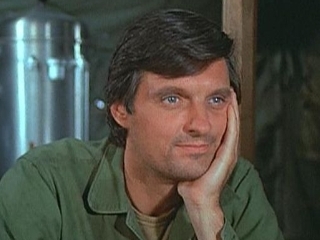
--Captain Benjamin Franklin Hawkeye Pierce, of MASH. That show was on a lot when I was a kid, and so it had an impact if for no other reason than repetition. Even as a kid, I tended to latch onto characters based on personality more than anything, and boy does Hawkeye have personality. He's a womanizer and is generally disrespectful of all things, but he still has a lot of heart. I think the trait that had the most lasting impression for me was his humor. I love a funny guy.

--Han Solo, of Star Wars. I'm not even a little ashamed of this one, although I probably should be. Han Solo was the one who started my hopelessly unhealthy love of bad boys. He was smart mouthed, he was sexy, and he had his own freaking space ship. What more could the young heart wish for? My very best friend as a child used to play Star Wars with me--he was Han, I was Leia. So it's no wonder that he was the first boy I ever kissed.


--Jafar, of Aladdin. This one I am vaguely ashamed of. Look, I know he's evil. I knew it even then. But...damn, I've always sort of liked villains. And there's something about him. He's dark, he's twisted, he's powerful. He turns into a snake, he locks people in dungeons, he hypnotizes sultans to make a grab for the thrown. I don't know. All I can say is that Aladdin never did it for me. He's a nice guy, but if I were Jasmine I'd have probably married the inappropriately older, evil, psychotic royal vizier. Which is yet more proof that I'd make a crappy princess.

--Angel, of Buffy the Vampire Slayer. And yet again, we come back to my attachment to unhealthy and impossible relationships. I always wanted to rewrite Angel's story to make it happy, and I always wanted to make me the star of that happiness. But I'm too lazy for fan fiction, and Angel is probably only good because it's tragic anyway. Angel made me latch on to the idea of redeeming a bad guy. Like, maybe Jafar and Captain Hook and Voldemort and Satan could all have happy endings if someone would just fix them. Or maybe they'd just end up more miserable. Seriously, screw you Joss Whedon.


--Sirius Black, of Harry Potter. In my defense, this was when there were only three or four books out and no movies. No Gary Oldman cast in the part, and not horribly abrupt death. He was a really minor character, but that was all the more reason for him to hold my curiosity. I think it was the wrongful conviction, escape from prison thing that did it for me. Plus the shape shifting. And he's loyal, he's courageous, and he's terribly reckless. Again, I wanted a happy ending for him. When he died, I got so mad that I actually put the book away and did not finish it for a good three months. It still hurts me.

So those were my early crushes, and I think it's easy to see why I love the characters I do today. Now it's your turn to share with the class: Who were your childhood crushes, and what made you love them?
Related Posts Plugin for WordPress, Blogger...